
Your container is clearing one of the terminals at Port Newark-Elizabeth (the Port of New York and New Jersey’s container terminals in Newark and Elizabeth) and your receiver cannot take a full ocean box at its dock. That leaves you with a simple, urgent job: get the box out of the terminal, get it opened, and get the freight onto pallets that a receiver or a domestic truck can actually take.
Container unloading, also called devanning, means taking the cargo out of an ocean container and setting it onto pallets or a warehouse floor, ready to store or send on. In full-year 2025 the Port of New York and New Jersey moved 8,897,531 TEUs, the busiest container volume on the East Coast, and the devan work happens at inland New Jersey warehouses, not at the terminals. Boxes are drayed inland, where crews open them, palletize the freight, and send it on. This page covers the terminal clock, the inland dray, and exactly what to send so a warehouse can quote your unload.
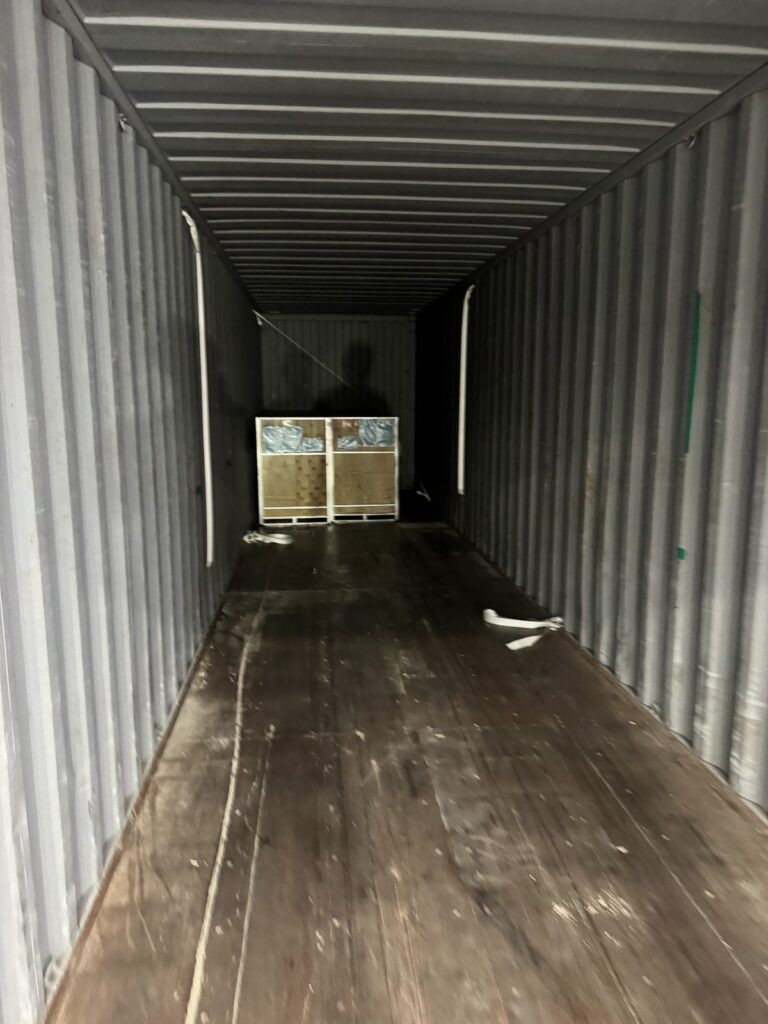
Your free time at the terminals is shorter than you think
The Port of New York and New Jersey runs six container terminals: Maher Terminals and APM Terminals in Elizabeth, Port Newark Container Terminal in Newark, Port Liberty Bayonne in Jersey City, Port Liberty New York on Staten Island, and Red Hook in Brooklyn. Free time is set per terminal, not per port, so the terms that matter are the ones at the terminal where your box sits.
One known scenario: at Port Newark Container Terminal, the published tariff (NY Terminal Conference Schedule No. 011408, effective October 5, 2026) gives dry imports 4 days of free time. Reefers, flat racks, platforms, and open tops get 2. Saturdays, Sundays, and ILA holidays do not count unless the gate is open. That is one terminal’s terms, not an all-terminal rule. Four days sounds generous until a release hold, a missed appointment, or a weekend eats half of it.
Once free time runs out, the meter starts. An industry drayage guide updated October 27, 2026 cites demurrage in the low two hundreds per day per box at the NY/NJ terminals, about $231 a day for days one through four under the NY Terminal Conference schedule and $222 at Maher. Those are guide figures, not guaranteed. Demurrage varies by terminal and ocean line. Your carrier’s demurrage and detention figures are the ones that will actually bill, and they move with the terminal, the equipment type, and the contract on your box.
Get your Last Free Day in writing from your carrier before anything is booked. Then put that date in the first message to the warehouse. A warehouse that knows the clock can plan the appointment around it. One that does not know is planning blind.
The devan happens inland, not at the terminals
None of the warehouses on the New Jersey map sit inside the port terminals. The box leaves the terminal on a chassis and gets opened at an inland warehouse, which means your plan has two parts: the dray to the warehouse, and the unload itself.
The northern listings sit where the Newark/Elizabeth drays naturally go. Secaucus sits minutes from the terminals off I-95 and Route 3. Dayton sits in central New Jersey by the Turnpike, around the Exit 8A area. Branchburg sits on the I-78 and I-287 corridor to the west. The inland dray is the ordinary move here, not an extra cost to be avoided: it is how boxes in this market reach a crew that can open them.
One geographic note for shippers pulling from the other side of the state: the South Jersey listings in Camden, Cinnaminson, and Swedesboro also serve freight moving through the Philadelphia gateway. This page stays a Newark/Elizabeth page, but if your box lands at Philadelphia instead, those warehouses are the ones to call.
Getting the box released and out of the gate
No truck collects a box the terminal has not released. Release terms, gate hours, and port charges shift over time, and all fees have to be settled before the container releases. Check the current requirements with your drayage carrier before dispatch, and get the paperwork settled first so the truck does not make a wasted run to the gate.
The working sequence looks like this:
- Confirm the release and get the Last Free Day in writing from your carrier.
- Book the dray and the warehouse appointment in the same planning, not as two separate afterthoughts.
- Agree live unload or drop with the warehouse and the carrier before the truck is dispatched.
A truck that shows up expecting one arrangement and finds the other burns the day and the free time together. Gate hours differ by terminal and can change, so the carrier confirms the day’s terms for your specific box.
Floor-loaded or palletized: ask the capability question out loud
Some warehouses take containers. Fewer take every kind of container, and the difference that matters most is whether the crew strips floor-loaded boxes. Floor-loaded freight arrives stacked loose on the container floor. The crew pulls it out piece by piece and builds it onto pallets, while palletized freight rolls out on a forklift. Same box, completely different staffing.
Industry guides put a floor-loaded 40 at one to two hours for a two-person crew, while a palletized box of the same size often clears in 30 to 45 minutes. A 40-foot high-cube commonly holds 24 to 30 standard pallets, and that pallet count drives the clock more than the container length does. Mixed loads, part floor-loaded and part palletized, run longer than either type alone because the crew switches methods mid-box.
Put your load type in the first line of your quote request. A palletized-only operation can be a fine warehouse and still be useless to you if your 40 is floor-loaded. You want to learn that before the truck rolls, not while it idles at a dock that cannot take the work. Heavy or oversized freight is a separate question again, so raise weight and size early and let the warehouse confirm it can take the load.
What drives the warehouse’s cost
No rate card is printed on this page, because a number quoted without your load details would mislead you. What the warehouse spends on your box comes down to box size, how the freight is loaded, how many pallets and SKUs the crew has to sort, weight, any wrap or label work, how fast the turn has to be, and how long the pallets sit after the unload. A floor-loaded sort that ties up a crew for hours prices nothing like a forklift unload that clears in one.
The dray is priced separately from the unload, so keep the two quotes apart when you compare. Book outbound trailers off your numbers, not a rule of thumb. Three 40s into two 53s is only true for lightweight palletized freight, and it is never a safe assumption. One loose-loaded 40 rebuilt onto pallets can take two dry vans by itself, while heavy palletized freight hits the weight limit long before the trailer looks full. Give the warehouse your pallet count and weight and let it pick the equipment for the load you have.
What happens after the box is empty
The unload is rarely the whole job. Once the freight is on pallets, it gets staged for pickup, held short term, split across several deliveries, or reloaded straight to outbound trailers. Tell the warehouse which ending you need in your first message, because the appointment and the crew plan change with the answer.
All listed warehouses handle split delivery, but you must explain the full scope when you first contact the warehouse: every destination and how many pallets go to each one. The warehouse can set up the outbound trucks, or you can bring your own, and that outbound prices by the truckload or by the pallet based on the load details and the warehouse’s rate structure.
On timing, the rule is the same one that applies everywhere: same-day help is often possible based on availability, and next-day is commonly doable, but the truck needs an agreed appointment time before it leaves. Rolling up to a dock that is not expecting you is not a strategy.
What to send so the warehouse can quote the job
Contact the warehouse you pick from the map directly and put the whole job in your first message. The reply comes from the warehouse itself, and normally lands within 24 hours or sooner. Appointment rules vary by warehouse, so ask about timing in that same first message rather than assuming a slot is open.
Put these in the message:
- Which box it is, 20 or 40, and whether the freight inside is floor-loaded or palletized.
- About how many pallets and SKUs, and whether anything runs heavy or oversized.
- Weight and dimensions of the items, or an itemized pack list.
- Arrival timing and how urgent the turn is, including whether the free-time clock is already running.
- The ending you need: pallets staged for pickup, held short term, split to several stops, or reloaded onto outbound trailers.
- Receiver limits, such as dock appointments, pallet specs, or a refusal to take full containers.
With that packet, a warehouse can say yes or no quickly and quote the actual job instead of asking three rounds of follow-up questions while the box sits at the terminal.
Find a New Jersey warehouse on the map
Search New Jersey warehouses on the map and pick one near Secaucus, Dayton, or Branchburg, then confirm with the warehouse directly that it devans your load type, has an appointment that fits your arrival, and can handle the outbound plan you need. This page does not pick a winner, so choosing the warehouse and confirming it fits the job is on you, before the truck rolls. For the wider picture of moving freight through New Jersey warehouses, see our New Jersey transloading guide.
Container Unloading at Port Newark-Elizabeth: FAQ
At Port Newark Container Terminal, dry imports get 4 days of free time and reefers and special equipment get 2, not counting Saturdays, Sundays, or ILA holidays unless the gate opens. Get your Last Free Day in writing from your carrier before anything is booked, and hand that date to the warehouse in your first message so the appointment gets planned around the clock.
At an inland warehouse. None of the warehouses on the New Jersey map sit inside the terminals, so the box leaves the terminal on a chassis and is devanned inland. For Newark/Elizabeth freight that means Secaucus off I-95 and Route 3, Dayton by the Turnpike, or Branchburg on the I-78 and I-287 corridor.
Decide it with the warehouse and the carrier before the truck is dispatched. In a live unload the driver waits at the dock while the crew strips the box, which avoids a drop charge but needs the dock, the crew, and the appointment lined up with the truck’s arrival. In a drop the carrier leaves the box at the warehouse and comes back later, which gives the warehouse scheduling room but adds a drop charge and keeps the per-diem clock running while the box waits.
Ask that exact question before you book, because not every warehouse strips floor-loaded boxes. Industry guides put a floor-loaded 40 at one to two hours for a two-person crew and a palletized box at 30 to 45 minutes, with mixed loads running longer, so put your load type in the first line of the quote request and let the warehouse staff the job around it.
That packet looks like this: box size and load type, rough pallet and SKU counts, arrival timing and urgency including whether the clock is running, what happens after the unload, and receiver limits such as dock appointments or pallet specs. Weight and dimensions of the items, or an itemized pack list. Send that packet straight to the warehouse you pick from the map and expect the warehouse’s own reply, normally within a day.
Yes. All listed warehouses handle split delivery, but you must explain the full scope when you first contact the warehouse, meaning every destination and how many pallets go to each one. The warehouse can set up the outbound trucks or you can bring your own, and that outbound prices by the truckload or by the pallet based on the load details and the warehouse’s rate structure.